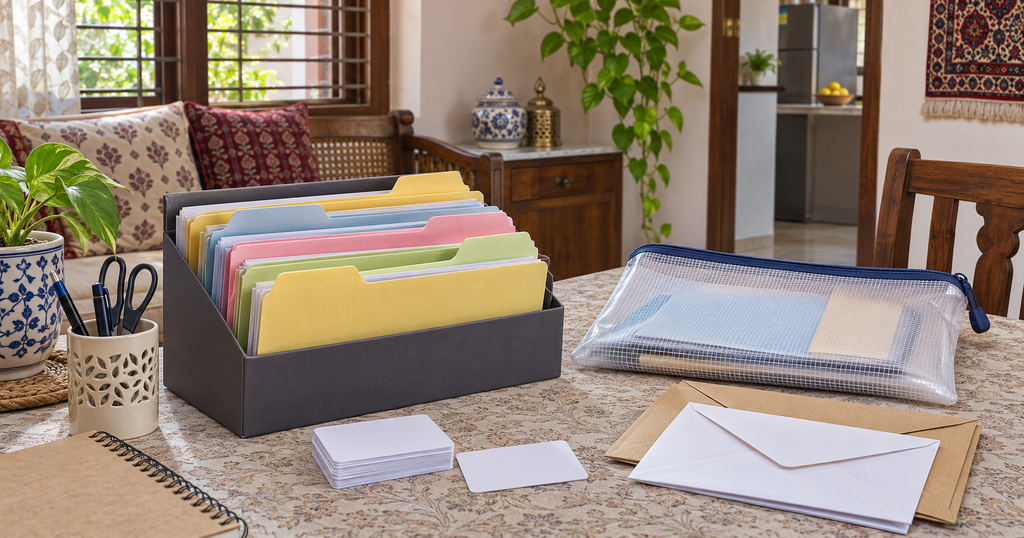
A family document folder that Pakistani households can maintain does not need an expensive organiser. Start with a folder you already own, a few dividers, and one place for papers that still need action. The aim is to find the right record without emptying every drawer.
This is a household organisation method, not an official document checklist. Schools, banks and public offices set their own requirements. A stored scan or photocopy does not automatically replace an original document.
Set up your family document folder.
Clear one table and sort a small batch first: the papers from one drawer or one bag. Separate originals from routine copies, remove duplicates only after checking them, and put anything uncertain in a review envelope. Do not discard a record simply because it looks old.
Use the table below as a starting point. Small families can share one folder; larger households can give each person an identity and education section while keeping household papers together.
| Divider | Pakistani household examples | Useful filing note |
|---|---|---|
| Identity and family | CNIC copies, CRC/B-Form copies, passport records | Identify the owner and where the original is stored. |
| Education | School admission letters, result cards, fee records, degrees | Separate current applications from completed records. |
| Home and services | Tenancy papers, property records, utility correspondence | Keep the latest relevant correspondence with its reference. |
| Health and cover | Prescriptions, reports and insurance documents | Limit access to sensitive information. |
| Purchases | Invoices, warranty cards and repair receipts | Keep the invoice with the product model and seller details. |
| Action pocket | Forms to submit, queries to resolve, renewals to check | Write one next action, owner and due date. |
Make pending work visible without exposing private data
Keep a small action sheet at the front. Write “school form — check photograph requirement — Friday” rather than a full CNIC number. Give each job an owner who can finish it, and move completed paperwork to the correct divider.
For example, a Rawalpindi family preparing a school application could keep the form, the school’s own checklist and requested copies in one temporary sleeve. The original birth or identity document stays in its protected location until genuinely required.
Keep protected copies and test them.
The American Red Cross includes copies of personal documents in its emergency-kit guidance. Its examples cover identity, home, and relevant medical information. For a Pakistani household, decide which equivalent records would actually be useful, rather than copying every paper into a bag.
Put necessary paper copies in a protective pouch and store important originals away from routine handling. A normal zipped folder is not automatically waterproof or fireproof. Check any protection claim instead of assuming the product name guarantees it.
For digital copies, use clear filenames such as “School_Admission_2026.pdf”. Check that every page is readable, and both sides are included where needed. Protect the device and storage account, keep a separate backup, and avoid sending a whole family folder when one document is requested. Keep banking PINs, passwords, and one-time codes out of the folder.
If scans are on a phone you plan to replace, use our phone data transfer checklist before resetting the old device. Open a sample document on the destination to confirm the transfer worked.
Use a short monthly review.
Choose a familiar monthly event, such as paying household bills. Empty the action pocket, file completed work, and check upcoming expiry or submission dates. Ask another trusted adult to locate one sample record using the divider labels. If they cannot find it, simplify the label.
Keep copies only for a clear purpose and review access when circumstances change. Retention requirements vary; check the issuing authority or a qualified adviser before destroying important financial, property, or legal records.
Reference and editorial method
Primary preparedness reference: American Red Cross emergency-kit guidance: https://www.redcross.org/get-help/how-to-prepare-for-emergencies/survival-kit-supplies.html
The divider system, local examples, action pocket, and review routine are Pakistani Price editorial suggestions. They are not an official application, legal-retention, or disaster-response standard.