An instant electric geyser is worth considering for a single tap or shower if it can deliver the flow you need in winter and an electrician confirms your home can support the load. A storage electric geyser is the simpler choice for many homes where family members take showers close together and can heat a tank beforehand. The right pick depends on how you use hot water, how cold your inlet water gets, and what your home can safely support.
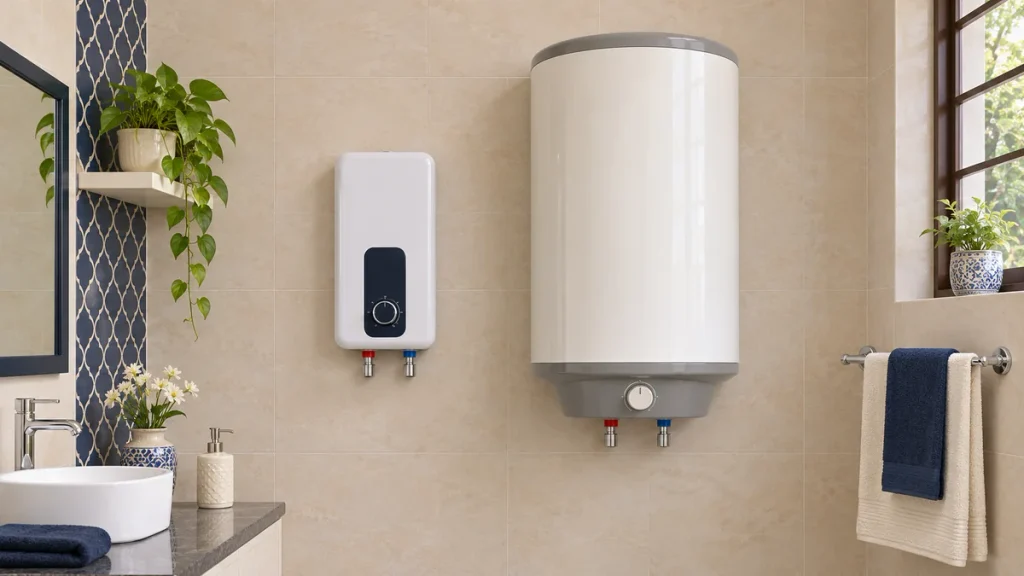
Table of Contents
- Instant vs storage electric geyser at a glance
- Electric geyser prices in Pakistan
- Which geyser suits your bathroom or family
- How many electricity units does a geyser use
- What to ask before you buy
- Frequently asked questions
- Final recommendation
Instant vs storage electric geyser at a glance
| What to compare | Instant electric geyser | Storage electric geyser |
|---|---|---|
| How it works | Heats water as it flows through the unit | Heats water in an insulated tank |
| What limits hot water | Flow rate and the temperature rise the unit can deliver | Tank capacity and how quickly the heater can reheat |
| Waiting time | No tank to preheat. Cooler water in the pipe still needs to clear | Requires time to heat the tank before use |
| Impact on electricity use | Can draw more power while running. Avoids heat loss from a storage tank | Can have a lower power draw while heating. A hot tank gradually loses heat |
| Where to start | One outlet with a known flow and a suitable electrical supply | A bathroom with repeated use and enough room for a tank |
Tankless sizing depends on both the litres per minute you need, and the temperature rise from incoming cold water to your target. A tankless model that feels fine on a mild day may deliver cooler water at the same flow in winter. See the Pacific Northwest National Laboratory sizing guide.
Electric geyser prices in Pakistan
These are listed appliance prices checked on 16 November 2026. Delivery, installation, and any electrical or plumbing work are separate costs to confirm. The three listings are examples of what you can shop for locally.
| Type and model | Listed price | Availability shown |
|---|---|---|
| Instant tankless — Daichi RP-55, up to 5.5 kW | Rs. 24,500 at Daichi | Order button shown. Confirm stock for the selected colour |
| Storage — NasGas NEG-30, 30 L, 2 kW | Rs. 22,200 at NasGas | Stock status is unclear on the listing. Confirm before paying |
| Storage — Boss KE-SIE-50CL Supreme SS, 50 L | Rs. 32,900 at Friends Home | Retailer showed next-day dispatch |
Buying tip. Read the specification line before comparing prices. If a product called “instant” or “semi-instant” lists a 15 L or 30 L tank, compare it as a storage model. For a tankless model, look for the rated power, minimum activation flow, and a flow-versus-temperature-rise chart.
Which geyser suits your bathroom or family
One bathroom with occasional use. Compare an instant model if you mainly heat water at one outlet. Ask the seller how many litres per minute the unit can deliver at your required temperature rise. For example, heating winter inlet water from 15°C to 38°C requires a 23°C rise. A quoted maximum flow on its own gives you too little information to judge that shower.
Two or more showers close together. Compare 30 L and 50 L storage models. A 30 L tank can be a starting point for short showers spaced out during the day. A 50 L tank gives you more stored hot water for consecutive use, though the time it takes to recover depends on the element rating and the water temperature. How many showers you get also depends on flow, duration, and how much cold water you mix in.
Two bathrooms used at the same time. Ask the installer to estimate the combined flow and confirm the unit can serve both outlets. If a compact instant model was sized for one shower, opening a second outlet can change the flow and temperature. For a storage system, check tank size, recovery time, and whether the plumbing can serve both outlets as intended.
How many electricity units does a geyser use
One electricity unit is 1 kWh. Heating 30 litres of water by 20°C takes about 0.70 units in an ideal calculation. A higher-wattage heater can deliver that heat in less time, subject to its capacity and flow. If hot-water use is identical, the water itself needs roughly the same amount of heat regardless of the heater’s power rating.
| Same amount of water and temperature rise | Ideal energy used | Approximate time at full power |
|---|---|---|
| 2 kW heater | 0.70 kWh | 21 minutes |
| 5.5 kW heater | 0.70 kWh | 8 minutes |
These are illustrative calculations. They leave out pipe and tank heat loss and assume full power throughout. A storage tank can use extra energy to stay hot between uses. An instant unit can also cost more to run if the household ends up using more hot water.
Using that same amount of water once a day for 30 days would take about 21 units for the water heating alone. At an illustrative Rs. 45 per extra unit, that is about Rs. 945 for the month before tank and pipe losses. Use the rate that applies to extra units on your own bill for a closer estimate.
What to ask before you buy
- Ask for the installed price. Get separate figures for the appliance, delivery, labour, and any electrical or plumbing work the installer identifies.
- Have a qualified electrician assess the exact model. Ask them to check your supply capacity, earthing, and protective devices against the manufacturer’s installation instructions. For a bathroom, have them confirm the permitted location and any required residual-current protection. A convenient plug point alone cannot establish suitability. See NEPRA’s Power Safety Code.
- Check water pressure and the mounting location. Give the installer the model’s pressure limits and minimum activation flow, where specified. For storage models, ask them to confirm the wall can support the filled unit and that there is room for service access.
- Get warranty details in writing. Ask whether the tank, element, electronics and labour have separate coverage, and whether the warranty requires authorised installation.
See our Home Appliances Buying Guide in Pakistan for more ways to compare running costs, warranties and after-sales support.
Frequently asked questions
The 50 L figure is the tank capacity. Warm water available at the shower depends on the tank temperature, incoming water temperature, mixing, and how quickly the tank reheats. A faster-flowing shower uses the available hot water sooner.
An instant electric heater stops heating when its supply is off. A storage geyser may still have hot water in the tank if it was heated beforehand and the home still has water pressure.
Only consider it if the model can deliver the combined flow at the required temperature rise and is designed to serve both outlets. Ask the installer to size it for both running at the same time.
Final recommendation
For one outlet, compare a tankless heater once you know the winter flow it can deliver and have confirmed that the electrical supply suits the model. For several showers close together, start with a storage model and compare 30 L and 50 L by tank recovery time, installation quote, and warranty. Those details are worth checking before paying a deposit.